

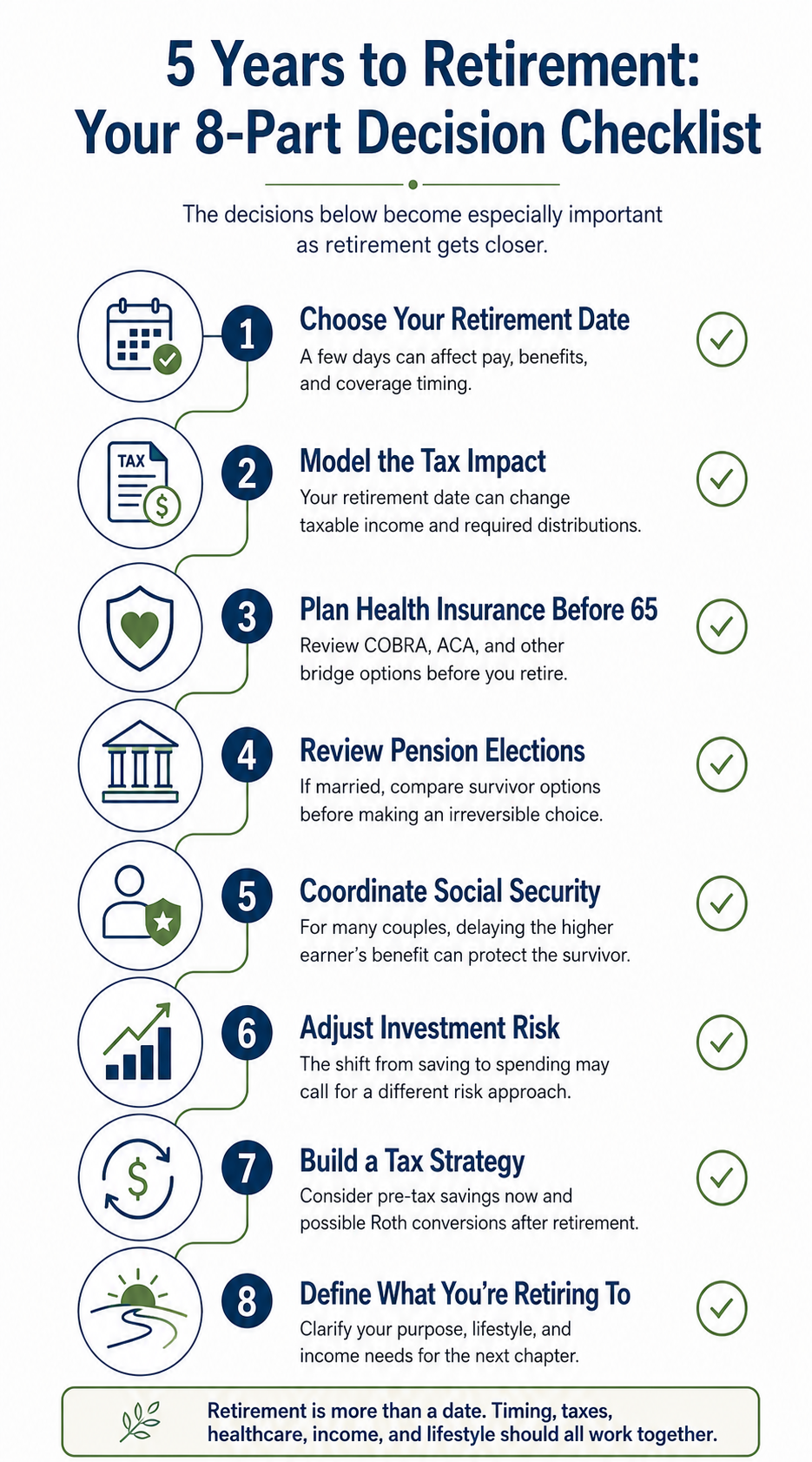
If you’re within five years of retirement, this retirement planning checklist can help you think through decisions that may be difficult, or impossible, to change once you retire. Your retirement date, pension election, Social Security timing, healthcare, withdrawals, and tax strategy can all affect what retirement ultimately looks like.
Retirement Planning Checklist
Here are eight important things to consider before you submit the paperwork. Use this retirement planning checklist to get a better understanding of what you may be missing.
1. Consider the Timing of Your Retirement
The day you retire can matter more than you might expect.
If your employer provides health insurance, consider retiring on the first or second day of the month so that you can potentially maintain coverage for the entire month, depending on your employer’s plan rules.
Retiring a few days earlier or later could affect when your employer-sponsored coverage ends and when your next coverage begins. It can also impact how long COBRA is available to you as a bridge to Medicare.
Before selecting your final retirement date, confirm the exact rules with your employer and insurance provider.
2. Think About the Tax Consequences of Your Retirement Date
If you are subject to required minimum distributions (RMDs), the date you retire can create an elevated tax situation or not. For example, if you retire on December 31, 2026 with retirement accounts and are over required distribution age, you have to withdraw funds for 2026. If you retire on January 1, 2027, you do not have to pull anything out for 2026. One day differences, saves a full required distribution.
For a real-world example of how continuing to work can affect RMD timing, Barron’s recently explored. Click here to check out the Barron’s article.
This isn’t necessarily the right strategy for everyone, but it’s an important question to model before choosing your retirement date.
3. Have a Plan for Health Insurance Before Age 65
If you plan to retire before age 65, one of the biggest questions is: How will you get health insurance, and how much will it cost?
If you retire at 63.5 or after with an employer that provides 18 months of COBRA, you can bridge the gap. But, if you retire earlier, the Affordable Care Act (ACA) created health insurance options for people who don’t have coverage through an employer. However, the ACA plans can vary significantly in terms of premiums, networks and providers who accept them.
Because these plans are not great options and often very expensive, we help our clients with more creative options like business plans as long as two non-related people are a part of the plan, and dropping your income substantially to qualify for subsidized top of the line plans through the ACA so at least you are getting the best that is offered. In some circumstances, these options can provide access to broader healthcare options at a lower overall cost.
Don’t wait until you retire to figure out your healthcare strategy. Understand your options and potential costs before choosing your retirement date.
4. If You're Married, Carefully Evaluate Your Pension Election
If you have a pension and are married, don’t simply choose the option that provides the highest monthly payment. If available, consider the joint-and-100%-survivor option.
A single-life annuity may provide a larger monthly benefit while you are alive, but payments generally end when you die. A joint-and-survivor option can continue providing income to your spouse.
Think about the consequences of choosing a single-life annuity and then dying shortly after retirement. The larger monthly payment may have come at the cost of giving your spouse no continuing pension income.
Age, health, other income sources, assets, and the relative financial security of each spouse should all be considered before making an irreversible pension election.
Having done the analysis for many pensions, in most cases, a single annuity or joint and 100% survivor (when available) is your only option. The other options like joint and 50% are not ideal at any combination of survivor ages.
5. Don't Overlook the Value of Delaying Social Security
For many married couples, it can be valuable for at least one spouse, often the higher earner, to delay Social Security until age 70.
Here’s why.
When one spouse dies, the survivor receives the higher benefit, subject to the applicable Social Security rules. This means the higher earner’s benefit can function as a form of longevity insurance for the surviving spouse.
Delaying the higher earner’s benefit can therefore provide greater guaranteed income later in life, when the surviving spouse may have fewer resources and higher healthcare or living expenses.
There are exceptions. A significant age difference between spouses, health considerations, and other circumstances can change the analysis.
The important point is to evaluate Social Security as a couple’s decision, not simply as two individual claiming decisions.
6. Reconsider How Much Investment Risk You Should Take
Many people assume that the older they get, the less investment risk they should take. But studies show this is not the case, and when you transition from saving to spending is actually when you should be most conservative. At this point, you are transitioning from accumulating assets to spending them, and your portfolio will be depleted the most (as you wait for social security for example) and need to support you for the longest time, often decades. A significant market decline early in retirement can be particularly damaging if you’re simultaneously withdrawing money from your portfolio.
As you age, however, the equation changes. You have fewer years of spending remaining, and often your focus increasingly shifts toward leaving assets to children, grandchildren or charities.
That can mean a portfolio could potentially take more investment risk later in retirement than it did immediately before or after retirement, assuming that level of risk is appropriate for the individual’s goals and tolerance.
The key is not to follow a generic age-based rule.
Instead, ask: What does my portfolio need to accomplish at each stage of retirement?
7. Think About Taxes Before You Retire…Not After
One strategy worth considering in the five years before retirement is maximizing pre-tax retirement savings, with the intention of deferring at higher income tax rates and then converting those savings to Roth immediately after retirement when your income is likely lower (thus introducing permanent savings in your portfolio added to tax free growth).
The goal isn’t necessarily to convert everything at once. Rather, you can potentially use the years between retirement and the beginning of required distributions to systematically move money from pre-tax accounts to Roth accounts while managing your tax bracket.
The tax strategy you use while working may be very different from the strategy you use once the paycheck stops.
8. Don't Just Think About What You're Retiring From. Think About What You're Retiring To!
Perhaps the most important question isn’t financial at all.
What are you going to do when you retire?
Work provides more than a paycheck. It provides structure, relationships, purpose, routine, and often a sense of accomplishment.
Before retiring, think about what will replace those things.
Will you:
- Travel?
- Spend more time with family?
- Volunteer?
- Start a business?
- Pursue a hobby?
- Exercise?
- Take on part-time work?
- Learn something new?
- Become more involved in your community?
Retirement isn’t simply the absence of work. It’s the beginning of a new phase of life.
The financial plan needs to support the life you want to live, but it helps to know what that life looks like before you decide when to retire.
Retirement Is More Than a Date
The final five years before retirement provide an important opportunity to coordinate the pieces of your financial life.
- Your retirement date can affect healthcare and taxes.
- Your pension election can affect your spouse’s lifetime income.
- Your Social Security decision can affect survivor income.
- Your investment strategy can affect how resilient your portfolio is during retirement.
- Your tax strategy can affect how much of your retirement savings you ultimately keep.
- And your vision for retirement can determine how much income you actually need.
Before you submit the paperwork, make sure you have considered the decisions that come after the retirement date, not just the date itself.
We can help!
Before You Choose Your Retirement Date, Know What You May Be Missing
If retirement is within the next five years, some of the decisions you make now may be difficult—or impossible—to change later.
Get a 30-minute Retirement Readiness Assessment. We’ll help you identify the three most important retirement or tax issues to address before you choose your retirement date and submit the paperwork.
If retirement is within the next five years, some of the decisions you make now may be difficult, or impossible, to change later.
During your Retirement Readiness Assessment, we’ll help you identify the most important retirement or tax issues to address based on your unique situation before you choose your retirement date and submit the paperwork.